 (Late post of last week's show...)
I don’t pretend to be a connoisseur of the Columbus hip-hop scene. In fact, my knowledge pretty much ends with a passing familiarity of the Weightless Recordings roster and Wes Flexner’s entertaining ramblings on local music blog Donewaiting.com. So I can’t really compare Envelope’s performance for Donewaiting’s six-year anniversary show at Skully’s last weekend with other hometown rappers’ performances. But man does this guy put on a great show.
First off, it’s refreshing to see someone put so much time and energy into an actual stage show, as opposed to just getting up there, staring at the ground and going through the motions. Envelope (aka Tony Collinger) billed the night as “Envelope presents The Corner Store,” and he meant that quite literally. The guy constructed a huge set (mostly out of cardboard, I think) for the stage--what looked like a corner store stocked with cereal, ranch dressing, Magnum condoms, chips, etc. It made for a long set changeover, but worth the wait.
Collinger comes off like a lovable goofball bounding around the stage--a far cry from ultra-macho, egomaniacal emcees obsessed with proclaiming their lyrical superiority and sexual prowess. He’s humble, yet highly entertaining, with a self-deprecating sense of humor. (On one track from 2008’s Blueprint-produced Shark Bolt, he says, “I’ll even admit that I’m annoyed when I hear too much of my own voice.”)
It was definitely a sloppy show. Collinger has a great flow but can’t sing for his life; luckily he usually asked the crowd to help out with the sing-along refrains (e.g. “I’m not poor, I’m just broke, broke as hell”). He also screwed up one of my favorite lines from “Oh My My My...,” a complaint about the letdowns of science: “They got wisdom like the Masons lack secrets.” But he made up for it with some other choice nuggets: “American Apparel’s owned by a sexual predator”; “Lost my swagger so I started jogging/ Beer gut, not so awesome”; “If we’re so smart, and nothing is left unexplored/ Then why’s it 2009 and I don’t have my hoverboard?”
He’s also more acutely perceptive than he gives himself credit for. “Day Dream Nation” does a pretty good job of diagnosing society’s ills and skewering the culprits--a group from which he doesn’t exclude himself.
And while an Envelope album is all about the smirky, everyman lyrics, an Envelope show is more about the experience. Just a playful, talented dude dropping rhymes, shouting out to his friends (like onstage deejay Detox) and acting out tongue-in-cheek skits with other friends (like The Catalyst). A fellow TOP critic described Envelope’s last album as quintessentially “Columbus,” and that goes for the Whetstone grad himself, too. Collinger unapologetically embraces this city, and we’d be right to return the favor.
Two Cow Garage gave one of its typical gerbil-on-a-speedball performances, with all the gusto and grit we’ve come to expect from the band, along with a near-overdose of catchy choruses. I’ve been doling out ego boosters to these guys a lot recently, so I won’t go on and on, but I have no qualms calling Two Cow the best live rock band in Columbus. Oh, and the drummer smashed half of his drum set on the last song.
I didn’t stay for laptop duo Adulture’s closing set, but the young’uns played some cool stuff in between acts, doing impressive live edits of Portishead and more. Moon High, a newish folk-inspired act I’ve been enjoying, opened the show with one of the most upbeat songs I’ve heard from the usually super-placid band. I’m excited to hear more of that. Musically, the rest of the set was pretty solid, too, but I tend to think atmosphere is more crucial than usual when watching Moon High perform, and Skully’s garish surroundings seemed to clash with the band’s aesthetic (foot-switchable globe lights, banjo plucking, tranquil songwriting). I’d rather experience the songs at a place like the Treehouse (where the band performed this past Friday with the Couch Forts) than at what someone recently described to me as “Columbus’s version of L.A.”
(Also at The Other Paper)
Sunday, February 1, 2009
Donewating 6-yr anniversary show: Envelope, Two Cow Garage, Moon High, Adulture


Thursday, January 22, 2009
Brian Harnetty - Treehouse, 1/16/09
 It’s amazing what can fall through the cracks.
The Other Paper (and this blog) dedicates a fair amount of increasingly valuable print space to local musicians, either trumpeting their fine contributions to the Columbus scene or providing some (hopefully) constructive criticism that readers can digest as an intriguing analysis, helpful caution or yet more proof that we’re a bunch of buffoons who must have been at a different show or listening to a different album.
But Friday’s show at the Treehouse just proves there is always more to discover in this city. Before a few weeks ago, I had never heard of Brian Harnetty, even though he released a well-received album on Chicago’s Atavistic Records in 2007. His stuff is utterly unique, though I should probably stop being surprised at Columbus artists who are doing things unlike anything I’ve heard before. Harnetty takes found sounds and archival material and weaves them together with his own instrumentation. For American Winter, he immersed himself in the Berea College Appalachian Sound Archives in Kentucky, eventually coming up with a composition comprising old field recordings of songs and interviews, plus radio addresses and other various sounds, combined with live instruments that unobtrusively thread it all together like gossamer connective tissue.
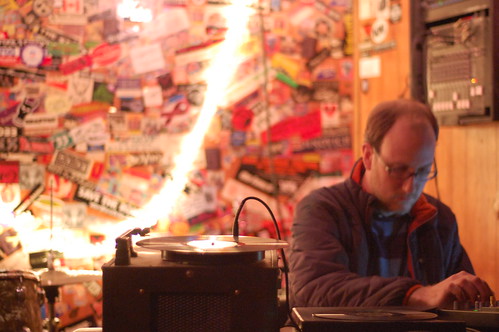
Harnetty rarely plays live, so experiencing his too-short set at the Treehouse felt like a privilege, and the venue’s naturalistic, homey setting was the perfect spot for the intimacy of these songs--except for the frigid temperatures in that back room on one of the coldest nights of the year. Brrr. It wasn’t a scintillating stage show by any means, nor was it intended to be--just the tall, unassuming Harnetty seated below the Treehouse Christmas lights with his gear and occasional sparse accompaniment from others on drums, xylophone, etc. It was a stark contrast of new and old, with a laptop and various knobby devices settled next to an acetate-spinner playing worn, scratchy vinyl, full of authenticating hisses and pops.
Listening to Harnetty’s pastiches feels like eavesdropping on the past. He often includes the moments just before or after an old recording of a tune, capturing revealing comments about songs, or just highlighting the ponderous and sometimes awkward moments when the singer finishes singing--to great effect on “That’s Drunkard’s Dream, Nearly Everybody Knows It.”
Harnetty never overpowers the source material. His subtle accompaniment on the keys and various digital devices lends a sense of deference to the recordings. It’s music to drop your head and close your eyes to. Most of what he played was from the coming Silent City, which will be released on Atavistic this spring. The exciting wrinkle to these new songs is that they sprang from a collaboration with Will Oldham (aka Bonnie “Prince” Billy), who sings over the new arrangements in a way that feels consistent with Harnetty’s previous work. It’s still dreamily Appalachian, and all the lyrics are folk-song fragments combined with phrases from Oldham and Harnetty.
This collaboration with Oldham, whose fans tend to obsess over his prodigious output, could bring Harnetty a new level of exposure, and for good reason. Judging by the tunes he debuted on Friday night, the new stuff is just as strong, if not stronger, than American Winter, retaining that archival quality while inviting a talent like Oldham into his ghostly world.
mp3: Brian Harnetty - That's Drunkard's Dream, Nearly Everybody Knows It
(Also at The Other Paper)
Wednesday, January 21, 2009
Animal Collective - Merriweather Post Pavilion
 I can’t believe it’s happening already. Despite the calendar date, people are calling Animal Collective’s new album, Merriweather Post Pavilion, the best record of 2009. And by “people” I mean “the Internet.” Oh, bloggers. Must you become a cliché so early in the year?
When you hit “play” on the first track, “In the Flowers,” you may wonder what it is that supposedly makes this latest effort such a cut above Animal Collective’s previous output (which, in my opinion, is spotty). The song sounds like typical, droney, abstruse Animal Collective. That is, until about the two-and-a-half minute mark, when the drums kick in, the blanket of synth changes and the vocals become a head-turning melody: “Then we could be dancing, and you’d smile and say, ‘I like this song.’” That line pretty much sums up this album. It’s Animal Collective--Avey Tare, Panda Bear and Geologist (Deakin is absent)--at its most danceable, and it’s Animal Collective in its most universally appealing and accessible form yet.
Now, “accessible” in Animal Collective terms doesn’t mean the band is about to jump on tour with Hoobastank. It just means that if you’re riding in the car with your parents, and you blast this album immediately after the band’s last one, Strawberry Jam, your parents might not hate you quite as much. It appears Animal Collective will always be psychedelic and experimental--and therefore always rankling to some ears--so listening to the band still takes some patience. But the payoff from time spent with Merriweather Post Pavilion is more rewarding than any previous AC album. And it’s really the thick, gurgly, electro-soundscapes these guys create that maintain the group’s experimental feel. If you extracted just the ’60s-pop vocals, they often wouldn’t be out of place in a sunny car commercial with a sedan navigating curvy lanes.
Even Animal Collective’s lyrics, which are notoriously inscrutable, are thematically stronger on this album, if only because a theme just may exist. Several of the songs--and snippets of others--are overtly sexualized. You can’t get much more straightforward than, “I really want to do just what my body wants to/ I really want to show to my girl that I want her” (from “Guys Eyes”). Sometimes it’s not quite as sexual (“I want to walk around with you”), but you get the feeling it’s all part of the pursuit. Plus, there’s all those freak-dancey beats driving the point home.
Other songs merely ruminate about everyday happenings (“Daily Routine”). Still, few people listen to Animal Collective to parse the lyrics. The songs, and Merriweather as a whole, convey mood more than message. There’s no reason to overly analyze a simple meditation like “I don’t mean to seem like I care about material things... I just want four walls and adobe slabs for my girls.” It’s best just to accept that “My Girls” is a great song.
One blogger recently made a rambling argument that Animal Collective was made for, by and on the Internet, meaning, Animal Collective wouldn’t exist without online communities of vociferous hipsters trumpeting their urbane musical tastes as much as they trumpet Animal Collective’s genius. That may very well be true, but that can be said for countless bands today, and to jettison any artist solely because of that is equally grating.
So whether Merriweather Post Pavilion is 2009’s best album is beside the point. What’s clear to me is that this band has created its best album yet, while also (potentially) increasing its listening audience. Let’s let that be enough.
Thursday, January 15, 2009
Animal Collective: Made by/for/on the Internet?
So says Hipster Runoff.
He makes some good points, I think, but I find that to be the most annoying writing style ever. Maybe I'm a curmudgeon, but I just can't stomach lazy, uber-Internet writing of that magnitude. Fr rlz.
Ghost Shirt, Couch Forts, Wing & Tusk, Phantods - Skully's
 Four local bands played Skully’s on Friday night, and the place was packed. I don’t know if these bands just draw really well, or that was the only thing going on. Or maybe Skully’s always does that well on Friday nights and I just didn’t realize it. Whatever the reason, bully for you, Columbus, for supporting the locals.
For the most part, the bands didn’t disappoint. I was most excited to Ghost Shirt, one of the city’s most promising new bands. Singer/guitarist Branden Barnett led the band through a set of meticulously arranged songs rife with magnetic hooks that felt vaguely familiar but rarely rehashed, taking lessons from the Lemonheads, the Kinks and, like any rock group that embraces its inner pop, the Beatles.
I liked the songs from other vocalist/guitarist Phil Palma, too, but Barnett rightfully took the center stage spot next to Ghost Shirt’s exceptionally smiley violinist. Barnett has an electric presence live, and his strong vocals keep the pretty melodies from ever sounding precious. The slow crooner of the night (“History of the Blue,” I think) was nice, too, though probably a little lengthy for this crowd.
Ghost Shirt apparently has a 10-song demo CD circulating, which I’d like to get my hands on, but I’m hoping I don’t have to wait too long to hear a proper release by this band.
Following up Ghost Shirt was Couch Forts, a three-piece of electric guitar, banjo and violin that drew me in with their extraordinary musicianship. The songs rarely contained chords, instead opting for intricately picked patterns on each instrument that merged to create a surprisingly streamlined melodic base. Somehow this trio made virtuosic complexity sound simple.
Singer/guitarist Owen Kelley sang with unpretentious nerdiness and vigor, sounding like a mash-up of John Darnielle and Colin Meloy. Then, whenever he punctuated the beat with a floor tom, he’d spit lyrics with an edgy impetuosity. I mentioned last week that Couch Forts fit in well with fellow Columbus quirk-folkies Our Cat Philip and Super Desserts, which is true, but this band is still one-of-a-kind stylistically. If three leprechaun musicians woke up one morning and decided to renounce their Irish heritage and supplant it with Appalachia, I think it would sound like the Couch Forts. (The band prefers a shorter description: “yellowgrass.”) The downside is, Kelley’s vocal cadence is so static and the vibe is so consistent that after a few songs it felt like one long song. Some more structural and vocal creativity in the songwriting would be welcome.
Having never seen Wing & Tusk live before, I probably mischaracterized the band a bit in my preview last week by describing its sound as “brittle, Pedro the Lion-esque folk-pop.” There’s definitely some Pedro the Lion in there, and some folk-pop in Wing & Tusk’s recorded material, but live, Wing & Tusk was much more grandiose and sweeping than I had anticipated. (Guess that’s what I get for going solely off a band’s two Myspace songs.) What was brittle, however, was singer Joshua Rea’s voice. I’m OK with brittle voices, but Rea seemed to be going more for reverby, majestic vocals--not unlike a more epic and less pastoral Band Of Horses--and his consistent vocal cracks messed with that feeling some. I don’t know if he was singing out of his range, or if he just a bad night.
That didn’t ruin the songs by any means, though, and the band’s swell-filled rock was a nice contrast to Couch Forts.
The place was still packed when Phantods took the stage to close the night. Gretchen King is Phantods’ main attraction; her soaring vocals are a treat to hear live. I also applaud the band for taking chances and tackling so many genres, often in just one song. But to my ears, the band’s various influences car-crash into each other as often as they complement. The wide swaths of head-banging, metallic guitar don’t always cozy up next to the carousel melodies and waltzy interludes. I’d love to hear more songs where the heavy riffage is toned down, or at least sounds more seamless and less surgically implanted.
(Also at The Other Paper)
Monday, January 12, 2009
Learning to listen
At a recent event hosted by the Grace Central Arts Guild, a group of people (myself included) did something extremely rare. We sat around and listened to music together. Each person brought a song on vinyl or CD to share--because it meant something to that person, or it was just a particularly great song, etc. (I brought "3 Broken Words" by the Black Swans because a. I love the one-of-a-kind, hand-painted vinyl packaging of Change! and the accompanying insert, b. the Black Swans' unhurried pace causes me to physically slow down and mentally take stock, and c. I think it's a shining example of music that's both gorgeous and forlorn.)
Getting together with other people for the sole purpose of listening to music seems like such a simple concept, and yet I can't remember another time in the last few years when I listened intently to recorded music while the people around me followed suit. In that intimate setting, I was amazed by how much I could appreciate a song--because of its musical strengths, sure, but more so because I listened to someone else explain why the song meant something to him or her. I can honestly say it's the first time I truly "got" opera.
I listen to music on my own all the time, of course, sometimes focusing solely on the album, sometimes just as background music. And, if you'll allow me to sound like a pretentious music writer for just a second, lemme give you a tip: If you really want to get to the bottom of an album, to truly understand it, listen with headphones. Not those standard-issue iPod headphones or old-school Walkman headphones. Really good headphones that allow you to hear all the intricacies of the recording. (They don't have to break the bank, either. I've got an in-ear set from Sony that's terrific.)
It may sound obvious, but I've found it's one of the only ways to utterly immerse yourself in the music--removing all other auditory distractions. Slowly, all the mental walls that prevent you from absorbing the music begin crumbling, and all that's left is you and the artist.
So, two challenges for the musically inclined (including myself):
1. Find time to listen to music--and discuss--with other people, and that's all. The only other thing on the agenda for the evening should be the brand of coffee or beer.
2. Listen to full albums alone on a nice set of headphones. (If you're the type who composes end-of-the-year lists, mental or otherwise, I'd wager that the albums toward the top will be ones you spent the most time with in this way.)
Friday, January 9, 2009
Charlie Louvin Sings Murder Ballads and Disaster Songs
 I’m usually not much for the unrealistic notion of beginning a new year with a clean slate, but as a music reviewer, it’s a good time to clean out the musical attic clogging my my brain. Digitally serviced zip files are vying for mental space next to watermarked promo discs and countless, breathless press releases promising the most genre-bending, life-altering batches of songs heard in decades.
A friend recently lent me some John Lee Hooker, and getting back to the blues has helped cleanse the musical palate. I figured some good ole country songs--of the grizzled, noncommercial variety--could do the same. Released in December, Charlie Louvin Sings Murder Ballads and Disaster Songs has filled that role quite nicely, though its appeal goes beyond my original, utilitarian intent.
There aren’t too many country singers with more cred than Louvin, now an 81-year-old Country Music Hall of Famer. Louvin and his brother, Ira, got their start as the Louvin Brothers, racking up hits on the country charts until Ira died in a car crash in 1965. Charlie continued on with a successful solo career, inspiring Gram Parsons (who famously covered “The Christian Life” and “Cash on the Barrelhead”) and the next generation of alt-country acts.
Louvin had a comeback of sorts in 2007 when Tompkins Square released his first album in 10 years, a self-titled, Grammy-nominated collaboration with folks like Jeff Tweedy, Elvis Costello and Will Oldham.
Tompkins also released a box set last year called People Take Warning! Murder Ballads & Disaster Songs 1913-1938, which apparently tickled Louvin’s fancy, since he included nine of those songs on this new album. Louvin’s got a cracker-jack band to back him on these vintage, three-chord country/folk songs, but it’s his worn, fraying vocals that give them a soul.
Some of the tracks are tragedies meant to break your heart (“The Little Grave in Georgia”), while others have a comedic edge (“Dixie Boll Weevil”). “Down with the Old Canoe,” which tells the Titanic story around the theme of hubris, serves as a warning so we can avoid such an untimely end by not getting too big for our britches: “When you think that you are wise, then you need not be surprised/ That the hand of God should stop you on life’s seas.”
“Wreck on the Highway” feels the most personal, as it could be right out of Louvin’s life. “There was whiskey and blood all together, mixed with glass where they lay/ Death played her hand in destruction, but I didn't hear nobody pray” goes one verse, and the sorrow is punctuated on each chorus, as Louvin sings at the top of his warbled, lonesome register, “I didn’t hear nobody pray, dear brother.”
It’s cathartic for Louvin, I’m sure, but the same goes for the listener. In this veteran’s take on old traditionals, even death itself can sound cleansing.
