Showing posts with label live review. Show all posts

Tuesday, October 27, 2009

Bob Dylan is coming to town

Dylan is playing the LC Pavilion this Tuesday, Nov. 3, and (fortunately) he hasn't been playing stuff from his recent Christmas album. I saw Dylan the last time he came to Columbus, at the Schottenstein Center, and I still hold that the man is worth seeing, growling mumble-singing and all.

So as a preview, I'm just going to post my review that ran in the Other Paper after that October 2007 concert—a defense, of sorts, for why it's still a big deal when Dylan comes to town.

Other than introducing his band Saturday night, Bob Dylan didn’t say a word to the crowd gathered at the Schottenstein Center. This isn’t rare for Dylan, and it actually makes sense. When you’re an American icon/legend/cultural revolutionary who’s now 66 years old, what’s left to say?

While writing this review, the same question tugged at my own brain. The piece is necessary, of course, because Bob Dylan came to town, and one can’t ignore a concert like that. And yet, it’s also entirely unnecessary because, really, what’s left to say? I won’t pretend to add anything groundbreaking to the vast amount of critical praise that has been heaped upon Dylan over the years, but from a practical standpoint, just know this: He’s still worth seeing. Very much so. And that’s what most people wonder about Dylan these days, isn’t it? Sure, we recognize and acknowledge his influence and the sense of history he carries with him, but is he still worth paying $40 to $70 (plus surcharges) to see in person? “After all,” you might say, “he never could sing too well, and I heard he can barely carry a tune now.” Dylan acknowledged this question Saturday night in the song “Spirit on the Water” when he sang, “You think I’m over the hill/You think I’m past my prime.” The audience collectively responded no, and they were right.

Bob Johnston, who produced Dylan’s Highway 61 Revisited, Blonde on Blonde and others, said in Martin Scorsese’s Dylan documentary, No Direction Home, “I think God, instead of touching [Dylan] on the shoulder, he kicked him in the ass. That’s where all that came from. He can’t help what he’s doing. I mean he’s got the Holy Spirit about him.” Sure, Dylan can’t sing the way he used to, and there was certainly a part of me wishing that I could hear him belt out, “How does it feeeeel.” But his other-worldly inspiration is still present; it just manifests itself in a different form these days, with Dylan in a wide-rimmed hat and cowboy boots rasping and spitting his lyrics as if they’re poisonous gravel that can only be spewed in short bursts.

Dylan also realizes the importance of a great backing band. The musicians were flawless and as tight as a band could be, following Dylan’s lead with ease--all he had to do was vaguely nod his head or slightly flick his wrist to indicate a change. Lead guitarist Denny Freeman was especially fun to hear, playing his solos with vigor and creativity while never upstaging the man we all came to see. Drummer George Recile established the groove for each song and added tasteful flourishes to keep it all interesting. Dylan only played his electric guitar on the first three tunes (“Rainy Day Women #12 & 35,” “It Ain’t Me, Babe” and “Just Like Tom Thumb’s Blues”), then stood behind the keys the rest of the night.

Other than those opening songs and closer “All Along the Watchtower,” the set list drew heavily from 2006’s Modern Times, mostly songs of love and heartbreak. The days of Dylan the protest singer are long gone, of course, but he can convey emotions in a surrealistic way that makes him just as relevant today. The fact that Dylan’s a creepy guy sometimes works in his favor, too--the renditions of “Ballad of a Thin Man” and “Ain’t Talkin’ ” felt vaguely downright haunting.

In “Thunder on the Mountain,” the first song of his encore, Dylan sang, “I’ve been thinking ‘bout Alicia Keys, couldn’t keep from crying... I’m wondering where in the world Alicia Keys could be.” It’s the perfect example of a Dylan song that’s simultaneously antiquated (uses a bluesy boogie structure), modern (references Alicia Keys) and somewhat inscrutable (Dylan’s looking for Alicia Keys?). He seems to realize that we’re continually drawn to what we don’t immediately understand, and Dylan certainly isn’t going to do any explaining for us, which is probably another reason he doesn’t engage in witty stage banter--all the puzzle pieces are right there in the songs. We just have to put them together.

Tuesday, August 25, 2009

Things

Here's what I've been up to lately over at The Other Paper:

Review of Paper Airplane's new CD, White Elephants (local)

Low Anthem/Langhorne Slim live review

Reviews of Monolithic Cloud Parade's debut, Children with Wolf Heads, and Wing & Tusk's debut, The Secret of Toadflax Tea (both local)

Live reviews of Bicentennial Bear, Miranda Sound, Jon Chinn + 1803 (locals)

Wednesday, June 24, 2009

Dirty Projectors - Wexner Center, 6-21

I imagine that by this point, David Longstreth, singer/guitarist and driving force behind Dirty Projectors, is tired of his band being referred to as “brainy.” It’s a tough tag to avoid when you’re a former music-major Yale grad who intricately crafts compositions that are near-impossible to categorize using other musical precedents.

The great thing about Dirty Projectors, though, is that anything that may come across as high-minded is balanced with something high-spirited, thereby dodging pretension. It takes significantly more knowledge and musical prowess than your typical rock band to sing and play the songs this band performed Sunday night at the Wexner Center. Yet the six musicians played with an organic ease and all the while maintained an electricity that was enveloping. (Not to mention the fact that, because the Brooklyn band’s van broke down in St. Clairsville on the way to the gig, they were playing with borrowed gear from the disappointing opener, Skeletons.)

Elvis Costello’s claim that writing about music is like “dancing about architecture” never rang so true as when attempting to describe Dirty Projectors. I could say that Longstreth conjures up the soulfulness and cadence of R&B singers; that the treble-heavy, snaking guitar lines have a distinct African influence; that the three supremely talented female singers contribute harmonies so complex that at times it’s difficult to even distinguish who’s singing; that the drummer’s big beats incorporate oddly-timed experimentalism, reggae and Led Zeppelin’s “When the Levee Breaks.”

But none of that really does it justice, especially those ladies—Haley Dekle, Angel Deradoorian and Amber Coffman—whose vocal theatrics were consistently the highlights of the show. “Remade Horizon,” off the recently released Bitte Orca, began with an extended vocal intro of start-and-stop, staccato harmonies that sounded so intricate yet so precise, like an entire section of computer-controlled woodwinds. And Coffman’s lead vocals on “Stillness is the Move” showcased a freakish range that could hold its own next to Mariah Carey, a singer she closely resembled on that tune. Coffman threw herself into the song, and her dancing only added to the impact.

It’s a little tough to relate to the lyrics, though, especially in a concert setting. These songs take a little while to comfortably settle. But Longstreth seems to be a lyricist more concerned with how the words sound than what they mean. The singers’ inflections and affected pronunciations convey a word’s impact more than its dictionary definition. The concert opener, “Two Doves,” which featured only Longstreth on guitar and Deradoorian on vocals, was one of the few songs that was entirely decipherable, a (love?) song with a refrain of “Call on me” that starts off describing a lover as a “geranium kisser, skin like silk and face like glass,” but later as a “geranium killer, throat of soil and mind like stone.” The soft song was the closest Dirty Projectors came to a ballad, and it was the prettiest of the night.

“Bitte Orca” wins the prize for most frenetic, cacophonic and virtuosic of the night. The level of choreography was breathtaking, as were the women’s preternatural, siren howls. I also enjoyed hearing “Rise Above” from the album of the same name, which was Longstreth’s re-imagination of Black Flag’s seminal 1981 debut album, Damaged.

Brainy? Yes, but this band-of-the-moment is also a lot of fun.

Wednesday, May 27, 2009

King Khan & the Shrines - Wexner Center

I’ll admit that when I first heard about King Khan and the Shrines, I wrote them off as another gimmicky band with a retro schtick. It all seemed like a big joke—the outrageous costumes, the sweaty, man-boob-bearing bandleader, the various genre-aping from the ’60s.

But last Thursday at the Wexner Center, I became a believer. I was putty in Khan’s hands, and from the looks of it, the rest of the crowd was, too.

After removing the aforementioned preconceptions, listening to King Khan and the Shrines is like rummaging through a box at Used Kids and discovering a dusty LP with a faded cover image and browned record sleeve, putting it under the needle and realizing you’ve just discovered an unfairly discarded relic of yesteryear. Eric Khan, the Montreal-born son of Indian immigrants, audaciously borrows from classic soul (think James Brown and Little Richard) and filters it through the Rolling Stones. It’s garage rock/punk with boundless enthusiasm, not unlike Vice Records labelmates the Black Lips, but with more bombast, theatrics and a sense of humor that could make robots chuckle.

Khan’s lyrics aren’t just tongue-in-cheek. They’re completely over the top, which matched his leopard-skin coat and the band’s matching gold-and-black outfits (including Bamboorella, a go-go dancer who gyrated with pompoms throughout the set). This is a guy who wrote a chorus that goes “My baby’s fat, she’s ugly/She’s fat and she’s ugly but I love her.” You can find that one, “Took My Lady to Dinner,” on The Supreme Genius of King Khan and The Shrines, which Vice released in the U.S. last year as a best-of compiled from his previous internationally released material. (Vice also released What Is?!, featuring some of the same tracks, last month.)

It can be pretty hilarious (and raunchy) but this wasn’t a comedy show—even when Kahn came out shirtless for the encore, beer gut flapping, with a golden cape and battle helmet. The band played some great tunes, and played them well.

While Wexner Center crowds are usually pretty tame, Khan had the Black Box on the Mershon Stage going nuts the entire time. I’ve seen a little bit of moshing here and there when punk bands play the Wex, but this was a whole other level. A room full of twenty-something white dudes (and some women scattered throughout) freaked out to the Shrines like college girls at a fraternity party do when they hear “Come on Eileen.” Insane. I even saw a guy up front smoking a joint and then attempt to pass it to Khan, who either ignored it or pretended to ignore it—a prudent move, since security was all over it.

The Shrines—all 10—were no less tame. The keyboard player made Jerry Lee Lewis’s antics look tame, and the guitarist was never stationary for more than a millisecond. I loved the double sax attack, plus trumpet. Songs like “69 Faces of Love” just scream for that horn section. I didn’t hear the percussionist much, but his oddball stage presence just added to the ambience. “Land of the Freak” revealed Khan at his James Browniest, and “Welfare Bread” (“You don’t have to pay your bills anymore now/You just have to eat my welfare breaaaaad”) sounded most like authentic doo-wop.

The shout-out to the New Bomb Turks, “Columbus’s finest,” probably scored him some points with the crowd, but there was no ingratiating needed. Khan was indeed king.

John Doe and the Sadies - Rumba Cafe

Decked out in a sharp-looking brown suit, John Doe welcomed the Rumba Cafe crowd to a “country-western Sunday jamboree” on Mother’s Day evening. And that’s pretty much what it was, as Doe led his backing band—immensely talented Canadian roots-rockers the Sadies—through a set of songs by country royalty like Johnny Cash, Porter Wagoner, Waylon Jennings and Merle Haggard.

Doe got his start back in the late ’70s playing bass and sharing vocal duties in X, one of the most influential and critically celebrated punk bands to come out of Los Angeles. Cult followers of X shouldn’t be too surprised to see Doe leading a country jamboree. X routinely used dashes of country and folk in its punk-rock recipe, and when the band reincarnated briefly as the Knitters (with Dave Alvin on guitar instead of Billy Zoom), it was more Carter Family than the Weirdos. And Doe’s first solo outing, Meet John Doe, cast off all punk leanings for a rootsy vibe.

Fast-forward almost 20 years, and the 55-year-old Doe has finally put out an album of almost entirely classic country songs. Country Club, released last month, pays tribute to the big boys, but Doe’s distaste of melodrama and the Sadies’ fiery musicianship and knack for nostalgic-yet-subversive arrangements allow it to be much more than a cover album.

The live show rose far above any cover-band cliché, as well. The band kicked off the night with Johnny Cash’s “I Still Miss Someone,” speeding up Cash’s signature boom-chicka-boom into a rollicking number. Doe’s worn voice was rich as a strong cup of coffee, and it fit this song and all the others perfectly. He joked that his acoustic guitar’s strings were just there to protect the finish, but it still added a nice texture.

The real guitar work, though, came courtesy of brothers Dallas and Travis Good. This was my first time seeing the Sadies live, and good golly can they play their instruments, which made instrumentals like “Sudbury Nickel” just as interesting as the other tunes. (It helped to have a near-perfect sound mix, too.) The brothers’ vocal harmonies also were spot-on; Dallas even took lead on a couple of tunes and showcased a shockingly good baritone.

Everybody on the stage was a showman, too. Doe has had decades to master communicating to a crowd, not to mention dozens of bit parts in movies and TV shows, and the Good brothers played all their parts with panache—even meeting at center stage to play each other’s guitar at one point.

Whatever kind of country floats your boat, John Doe and the Sadies played it, albeit filtered through their own signature sound. There was ’70s Nashville (Tammy Wynette’s “‘Til I Get it Right”), outlaw country (a smoking version of Waylon Jennings’ “Stop the World and Let Me Off” and an ever-so-slightly psychedelic take on Kris Kristofferson’s “Help Me Make it Through the Night”) and Bakersfield honky-tonk (Haggard’s “Are the Good Times Really Over for Good,” with the timely line, “Wish a Ford and a Chevy could still last ten years like they should”).

While Doe mentioned a few different times how disconcerting it was to have the sun shining through the window while the band played (it was an early show), the whole experience was anything but disconcerting. Rather, it was one of the most fun, refreshing shows I’ve seen this year.

Thursday, May 7, 2009

Pains of Being Pure at Heart w/ Zaza, Tin Armor - The Summit

On the stage of the Summit Friday night, all the non-drumming members of The Pains of Being Pure at Heart stood at the edge of the stage, leaning over with their instruments, looking as if they were ready to jump into the crowd. If they weren’t all so mild-mannered.

That combination of rock ’n’ roll ebullience and reserved timidity has served the Brooklyn band well. There are the big, fuzzy guitars that make comparisons to shoegaze forebear My Bloody Valentine too easy, but then there are the twee melodies led by singer Kip Berman’s unaffected vocals, which bring to mind the indie pop of Belle & Sebastian.

There are other bands we could start adding to the recommended-if-you-like list (some people swear all they hear is the Smiths), and each name on the list would simply magnify that sense of nostalgia you get when listening to the Pains of Being Pure at Heart’s self-titled debut.

But the reason this band has garnered so much hype and press this year—well beyond the realm of fawning bloggers—is that: a.) Nostalgia is fun when it’s done in a way that avoids mimicry, and b.) Pains combine noise and pop better and more accessibly, in my opinion, than other bands who have recently attempted to revive the merging of those two seemingly disparate qualities. (I’m looking in your direction, Vivian Girls.)

There’s not too much that can be said about the Pains of Being Pure at Heart on record that can’t be said about the band live. If the mix is good enough, which it was at the Summit after a couple of songs, it’s pretty much like hearing the album. Berman sang his parts with a blank, doe-eyed stare to complement his easy, unassuming voice, and the rest of the musicians played their parts well—all with a kind of dorky-but-endearing vibe. It wasn’t mind-blowing, but it was a good representation of the band and made for a fun set.

On the other hand, Zaza, which was also on the bill, greatly disappointed. I had downloaded the band’s free EP from its website and liked what I heard—ethereal vocals, droney grooves and cool atmospherics. But live, the Brooklyn trio seemed to take itself way too seriously. It was pretty boring. To make things worse, the band insisted on using two high-beam lights as its only means of lighting, and one of those lights bounced off the Summit’s mirrored wall into the crowd, blinding a good portion of the audience. Donewaiting Duffy eventually got all MacGyver on the situation and blocked the reflection with some boxes, but even without Zaza’s stage props burning my retina, it was still boring.

Local opener Tin Armor has had some good slots recently, opening for Matt & Kim at Skully’s a few weeks ago. The band has earned those slots, too, because each time I see these guys, I like them more. There’s some punk fervor in there, plenty of pop sensibility and two equally strong singer/songwriter/guitarists to boot. Fans of Ted Leo, take note, and keep your eye on these young locals.

Thursday, April 30, 2009

Neko Case, Crooked Fingers - Newport Music Hall (last Thursday)

Singers with alt-country panache are a dime a dozen these days. Much of it is pretty, pleasant, safe and, to be honest, quite average. And I say that as someone who’s drawn to that stuff more than most.

On the surface, Neko Case doesn’t seem to have much that sets her apart from all the others in this loosely defined genre. She sings with vague country overtones that convey deference to the rich history of the American South, yet it’s subtle enough that an adjective like “twangy” would be jarringly inappropriate. Plus, her band incorporates lap-steel guitar, and Case herself often plays a four-string tenor guitar, an instrument long associated with country music (along with jazz and, later, folk).

And yet a Neko Case song is unmistakable, often executed with a brilliance that has rightly expanded her fan base far beyond the NPR-and-latte set. It all starts with her voice, which was in full force at the Newport last Thursday. One of my fellow reviewers has stated his disdain for Neko’s singing. To each his own, because I found Case’s bold, open-throated vocals a thing of beauty live, just as it is on record.

The Newport’s muddy sound system and generally talkative crowds don’t make for an ideal atmosphere in which to soak in all that good stuff, but it didn’t ruin the experience by any means. It did, however, make it difficult to decipher some of the words, which is a shame because her imagistic lyrics often get overlooked amid all the gushing over her voice.

“I Wish I Was the Moon,” a fan favorite from 2002’s Blacklisted, showed her sweet balladeer side, with the lonesome refrain “I’m so tired, I wish I was the moon tonight.” At the end of the set, “Dirty Knife” revealed a more disturbing side (“He laid down on the floor and he slept like iron/While the dirty knife worked deep into his spine/The blood runs crazy”). Both fit Case like a glove, effortlessly transitioning from pining to haunting.

The female backup vocalist filled out the sound nicely, though she was way too talkative between songs. Someone needs to remind her she’s a backup singer.

About halfway through the set, I got a little impatient for more Fox Confessor Brings the Flood tunes, but overall there was a pretty good mix of songs both new (“Middle Cyclone,” “People Got a Lotta Nerve”) and old (“Deep Red Bells”).

It’s rare to read anything about Case without mention of her long, red hair, and most of the press photos have only served to further her image as a sex symbol. But in concert Case came off like the farm girl that she is (she’s an animal lover with 100 acres in Vermont), devoid of anything diva. She even self-deprecatingly displayed her oddly shaped navel to the crowd, explaining that someone told her it looked like a dolphin.

Case excels outside the alt-country ghetto, too, adding her pipes to the New Pornographers, as well as guesting on a recent song by Crooked Fingers, who opened the show. Bandleader Eric Bachmann, who helmed influential mid-’90s indie darlings Archers of Loaf, suffered from a worse sound mix, but nevertheless played a good, short set that left me craving a full Crooked Fingers show.

While it’s doubtful that Archers of Loaf would have shared the stage with Case, Bachmann has become more entranced with folk structures and Springsteen since starting Crooked Fingers. (“Sleep All Summer” was a good example of the former, “You Can Never Leave” of the latter.) I missed the string and horn arrangements that a three-piece with keys and a half-kit couldn’t offer, especially on “Phony Revolutions,” but the songs still held up.

One thing, though. If you decide to play a song that, on record, is a duet with Neko Case, why wouldn’t you work it out so that she could come out and sing it live? What a missed opportunity.

(Also at The Other Paper)

Thursday, April 9, 2009

Dr. Dog, Golden Boots, The Lost Revival - The Basement

The original plan Monday night was to check out the Cave Singers and Golden Boots, both slated to open for Dr. Dog at the Basement, then skip the headliner and shoot up north to see San Diego buzz band Crocodiles take the stage at Cafe Bourbon Street. It’s not that I dislike Dr. Dog. In fact, I quite enjoyed the Philadelphia band’s 2008 release, Fate. But I saw them at CD101 Summerfest last year and they didn’t blow me away. Plus, the strength of Crocodiles’ upcoming Fat Possum debut, Summer of Hate, coupled with rumors of stellar SXSW performances, had me jazzed for that show.

But Crocodiles canceled. Then the Cave Singers canceled. And yet, it turned out to be a pretty good night.

I walked into the Basement as a band I assumed to be Golden Boots was playing, but was pleasantly surprised when I saw eight people crammed onto the stage and realized it was the Lost Revival. The local band apparently was asked to fill in for the Cave Singers just a couple of hours earlier. I’d have enjoyed the Lost Revival even if I hadn’t known that the band a.) had to throw everything together in a matter of hours, and b.) played almost all brand-new songs. Singer/songwriter Kevin Collins was just born to be a front man. His throaty singing, interspersed with a strong falsetto, gives the folk-inspired, synth-laced epics a primal texture that’s missing from so many bands that use Americana as their undercarriage. And the man has charisma to spare.

My only complaint with the short set was that the female background singer was consistently flat and too loud, which at times detracted from Collins. But mostly it was good, chaotic fun. It’s encouraging that after the Lost Revival’s strong debut, Homemade Confetti, the new songs are more focused, with even stronger hooks (see “Cotton and Lace” and “Mayqueen”), yet still grand and gutsy. The addition of saxophone was cool, too.

Next up was Dr. Dog labelmates Golden Boots, a band I’m more impressed with on record. The group incorporates southwestern sounds from its hometown of Tuscon, Arizona, but on the recent Winter of Our Discotheque, there’s more experimental, fuzzy psychedelia. At the Basement, the band played the songs pretty straight, with little deconstruction or even slightly fractured pieces. Neither of the two singers drew me in, and having two drummers seemed completely superfluous. I’d still recommend picking up Winter of Our Discotheque, but skip the live experience.

Dr. Dog, on the other hand, was in its element, feeding off the energy of the sold-out crowd. At Summerfest last year, the band seemed a little lost on the huge LC Pavilion stage, but the Basement’s modest digs proved to be more comfy. It was the difference between a sprawling storm system dropping scattered thunderstorms here and there and a funnel cloud concentrating its delivery with consistent ferocity.

(I’ve gotta say again, though, that though the Basement seems like a good venue for bands, it’s a horrible venue for every concertgoer except the 50 to 75 people up front, and a sold-out show only re-emphasized that. There’s a reason stages are usually above the audience, not below. No one should pay for a show and end up having to watch it on a lousy TV behind the bar. So it’s a good thing the band used the venue to its advantage, because there’s virtually no advantage for the fans.)

Dr. Dog has had more time to tour behind the the new material, and it showed. I still enjoy bassist Toby Leaman’s singing best, especially in a live setting. Songs like “The Ark” and “The Beach” are groovin’ head-nodders, due much in part to their bass lines, and Leaman’s sandpaper howling was the fuel for the fire. The band’s other singing/songwriting half, Scott McMicken, was on, too, especially during “The Old Days” and encore closer “Ain’t It Strange.” All the vocal harmonies were dead-on, too.

So despite my disappointment at the evening’s outset, the band reclaimed my affections. Dr. Dog had its day.

(Also at The Other Paper)

Wednesday, April 1, 2009

The Antlers - Cafe Bourbon St., 3-26

Depending on their subject matter, concept albums have the potential to alienate listeners. Even the term “concept album” sounds a bit pretentious. But the truly great ones transcend story-line, using the thematic material to communicate ideas, questions, truths, emotions--or all of the above--common to the human experience. In other words, you don’t need to be a deaf, dumb and blind pinball champion to appreciate the Who’s Tommy.

The Antlers’ new album, Hospice, uses a fractured relationship between a hospice worker and a young, terminally ill girl (Sylvia) to muse about mortality and all its repercussions--loss, loneliness, anger, empathy, guilt and the like. Singer/songwriter Peter Silberman, whose lyrical and compositional maturity belie his age (23), switches vantage points throughout the album, allowing glimpses into each character’s inner workings.

Complicating matters--in a good way, it turns out--is the patient’s condition. She apparently has cancer, but it’s her mental illness and the resulting nightmares and visions that make the relationship so antagonistic and heartbreaking. In the liner notes, Silberman explains (in character of the hospice worker, it seems) that “something makes her sting, and something makes her want to kill. It made her crawl under that house, and stick her head under the stove.”

The Antlers punctuate the interactions with huge swells of sound that wouldn’t be out of place on a Sigur Ros record, and subdued sections anchored by a gingerly tapped piano or lightly strummed acoustic guitar along with shimmery, atmospheric synth textures (see “Kettering”). It’s in those quiet portions that Silberman employs his greatest attribute--a beautiful, alabaster falsetto that’s more hushed than Jeff Buckley but less wispy than Antony and the Johnsons.

Ah yes, but this is supposed to be a live review, right? The Antlers did, in fact, play Cafe Bourbon Street last Thursday as a three-piece, though few were there to see it. (Our Cat Philip, however, did not open the show, to my disappointment. Bourbon Street’s website is notoriously inaccurate. Get on the ball, Bobo!) The mostly empty bar lent the show a vibe that was more flat than intimate, and the band hasn’t completely figured out how to replicate Hospice live yet. The climaxes were even more powerful when heard at arm’s length, but the subtleties weren’t quite as subtle. And I missed the acoustic.

The hardest thing, Silberman sings on “Wake,” is “letting people in.” He wisely jumped that hurdle with the Antlers, beginning Hospice as a solo project and gradually adding contributions from others until the Antlers became a real band, not just a nom de plume. It’s a potent combination on record, but the band needs some more road-testing to match that chemistry onstage.

Still, despite those shortcomings and an incredibly short set, I’m glad I ventured out. I particularly enjoyed “Shiva,” as well as the sheer epic-ness of “Atrophy,” with its desperate coda: “Someone, oh anyone, tell me how to stop this. She’s screaming, expiring, and I’m her only witness.” Haunting, but really pretty.

So yes, the Antlers are worth seeing live, but more importantly, go pick up or download Hospice. And when you do, listen from beginning to end. It’s a concept album that demands and rewards your attention.

Photos from the show
mp3: The Antlers - Two
mp3: The Antlers - Bear
The Antlers WOXY Session

Friday, March 6, 2009

Matt & Kim, Hollywood Holt, Tin Armor - Skully's

From the moment Matt & Kim played their first note at Skully’s on Friday night, a guy standing in front of me gripped the railing of the stage, closed his eyes, threw his head back, smiled and moved to the beat. He didn’t stop until the final note was played.

At some indie-rock shows, a guy like this might stick out like a pair of pressed khakis. But I only noticed him because I was watching the show from the comparatively sedate side stage. From the front of the stage almost all the way back to the bar, enthused kids threw their hands up, danced, gyrated, shouted along and generally immersed themselves in the music coming from this keyboard-and-drums duo. I even saw someone skipping. While a scene like this is somewhat of a rarity at a Columbus rock show, at least at most of the venues I frequent, I get the feeling it’s standard fare for Matt & Kim--the smiliest couple in indie rock.

Though I’ll happily put on the duo’s sophomore album, Grand, when the mood strikes, I admit the couple’s youthful exuberance and Matt Johnson’s prone-to-cracking, slightly emo vocals don’t knock me out on record. But in a live setting, watching Kim Schifino pummel her floor tom with affixed perma-grin and seeing Johnson bang out the opening notes of “Daylight,” the giddiness is contagious as a runny nose.

It was odd that with a live show this good, the two screens behind the pair just rotated fairly boring images of words like “Grand” and “Matt and Kim.” The only cool image was some exploding fireworks. It didn’t detract from the vibe, but I imagine with some more time and thought put into the projections, wide-eyed fans’ heads would explode.

Heeding the “simple is better” punk philosophy, almost all of the tunes were propelled by Schifino’s simple beats. I was happy to hear all three of Grand’s opening trifecta--“Good Ol’ Fashion Nightmare,” “Cutdown” and “Daylight”--at some point in the evening. They’re the best songs the two have written. Before the last song of the night, Johnson stood up and gave a passionate, endearingly idealistic speech about supporting Obama, remembering everything in life and trying hard, followed by the only (seemingly) unironic rendition of Europe’s “The Final Countdown” I’ve ever heard.

Chicago rapper Hollywood Holt did a good job of getting the crowd all riled up, despite being relatively unknown and employing a sheepishly green deejay (“DJ Skyler”) prone to screwing up. Judging by the five to ten friends roaming the stage taking pictures and video, Holt is pretty new to this game. But he was determined to get the place moving, and his mix of old-school rhymes, crunky beats and vaguely punk influences did the job.

Like Matt & Kim, Hollywood ain’t afraid to make you smile, with lyrics about the cleanliness of his clothes and the recent purchase of a moped. For some reason, I also found his onstage sidekick hilarious (in a good way), so that helped, too. Fans of party rap, electro and the Beastie Boys should find much to like.

I forgot that I’d seen opener Tin Armor before when the band opened for Frightened Rabbit and Spinto Band, so I guess the locals didn’t leave a big impression on me. But I really liked what I heard this time. The band’s blend of punk, pop and rock just felt more put together, feeding off the energy of a full house. This time I’ll remember.

Wednesday, February 25, 2009

Southeast Engine, Frontier Ruckus, The Coke Dares, The Kyle Sowashes - Treehouse

With four bands on a bill, it’s more than likely one of them is going to be a dud, or at least have an off night. But the Treehouse was four for four on Friday night.

The main event was the release of Athens, Ohio’s Southeast Engine newest offering, From the Forest to the Sea. As I mentioned last week, it’s a record full of spiritual yearning and self-condemnation, and it’s also one of the best albums released so far this year. What struck me most about Southeast Engine’s indie-folk live is how well bassist Jesse Remnant’s tenor harmonies complement singer (and brother) Adam Remnant’s wonderfully crackled voice--one filled with meandering eccentricities that wouldn’t be easy to harmonize. Watching the Remnants belt out the melodies in fraternal sync was one of my favorite parts of the night.

The set was heavy with new stuff, and I liked the loose, spacious feeling the live setting lent to the songs. Foot-tapping rockers like “Black Gold” and more restrained numbers like “Law-Abiding Citizen” and “From the Roots of the Mountains to Your Holy Temple” came together superbly beneath the Treehouse lights.

Taking the stage before Southeast Engine was Michigan band Frontier Ruckus, a stylistically perfect choice to go with the Remnants and company. I only caught a few songs, but it was enough to convince me to pick up the band’s debut full-length, The Orion Songbook. I highly recommend it. After listening to it the morning after the show, I couldn’t wait to press play and start it all over again. That doesn’t happen very often.

Songwriter Matthew Millia has created a bunch of folk-inspired songs about the mythological Orion Town, and the band fleshes out his singular voice and imaginative, literate lyrics with deft acoustic guitar, singing saw, trumpet, banjo and lovely female harmonies. The songs, whether “Bethlehem” or “Adirondack Amish Holler,” convey a vivid sense of place. Really good stuff.

The second half of the night was a completely different style of show. Part II was jovial, with significantly less weighty subject matter--just lots of laughs and endless energy. The Coke Dares, from Bloomington, Ind., had one of the most original sets I’ve ever seen and were laugh-out-loud funny. Until the last song, the trio, wearing black T-shirts that said “The,” “Coke” and “Dares,” respectively, didn’t play one song longer than about a minute and 30 thirty seconds. Some were even under 30 seconds, but each one packed a punch. It wasn’t rare to have a song’s title contain the majority of the lyrics, e.g. “I’m Gonna Love You Like a Hot Teen.”

Meditate, if you will, on “Wood,” which clocked in at about 30 seconds: “If you’re gonna make it, make it good, you’re gonna wanna make it outta wooooood.” “Tour Rot” told the (brief) story of playing at Bernie’s when one of two people at the show threw up at the band’s feet. “Rocking all the Time” told of the band’s love for whiskey, pills, wine and, of course, rocking all the time. With a sound that’s aptly been described as a mix of Guided By Voices and the Ramones, you’d never know these dudes also play in Magnolia Electric Co.

The most shocking and hilarious moment of the set came as the band wrapped up its supposedly last song, and then launched into an extended version of Pink Floyd’s “Shine on You Crazy Diamond,” with lots of faux endings along the way. It also proved singer Jason Groth is a ridiculously talented guitarist. I can’t say I’d listen to these guys on record a whole lot, but I advise you not to miss an opportunity to see them live.

The Kyle Sowashes kept the energy level high, as is their custom. I think everything Sowash does translates better live, in a whirlwind of guitar, beard and thick, black-rimmed glasses. “My Resume” from last year’s Yeah Buddy! sounded great, and all the more applicable lyrically because of what people like to call “the current economic climate.” And Sowash’s everyman goofiness shone through on “Rumours”: “When I was small, I had it bad for Stevie Nicks/ I just stared at the back of Fleetwood Mac until the age of six.”

The strong set of Sowash-stamped, throwback indie rock was a fitting finish to a night of unusually good music.

mp3: Southeast Engine - Black Gold
Southeast Engine Daytrotter Session
mp3: The Coke Dares - Wood

Tuesday, February 17, 2009

Times New Viking <3 the Velvets

Just about any band that veers off rock’s beaten path owes a debt of gratitude to the Velvet Underground. The band’s Lou Reed-led, Andy Warhol-produced The Velvet Underground & Nico and pretty much each boundary-pushing album thereafter conveyed a message: Rock is something to be messed with. It can be a form of art, and, as such, experimentation is a part of the process.

Given that legacy, Columbus’s hometown breakout art-rock icon Times New Viking was the perfect pick to pay homage to the Velvets last Saturday in a Wexner Center concert celebrating the final weekend of the Andy Warhol: Other Voices, Other Rooms exhibition. It’s probably not overstating to say that Times New Viking (and a host of other bands) wouldn’t exist without the Velvet Underground.

And yet, since TNV’s boundary-pushing comes in the form of fuzzed-out pop songs that rarely make it past the 2 1/2-minute mark, there was a palpable sense of a curiosity and anticipation surrounding this show. How would Times New Viking interpret a seven-minute, dynamic-laden song like “Heroin”? Well, the band proved right away that it doesn’t mind taking a break from short shout-alongs to get all long and droney, and even (no joke) jam. “That’s already longer than most of our sets,” joked drummer/singer Adam Elliott after the first song, “Run Run Run,” off The Velvet Underground & Nico, from which the band drew the bulk of its material.

Times New Viking also had some help from a couple of friends: Mike Hummel--the white-haired elder statesman of the Columbus rock scene who’s perhaps better known as Mike Rep of Mike Rep and the Quotas--added guitar and vocals, and Cincinnati’s C. Spencer Yeh of Burning Star Core contributed squeals, squalls and drones on violin. TNV guitarist Jared Phillips used his usual Strat/Marshall setup, but singer Beth Murphy often took a break from the analog synth to play a bright red guitar. (If you’re counting, that’s three simultaneously strummed guitars at a Times New Viking show.)

The super group’s re-appropriations made for a mostly gratifying Valentine’s Day show. I’ll just get a couple complaints out of the way, the most glaring of which was Hummel’s guitar. It was consistently way too loud, which is a shame since the stuff he was playing added a lot. But he continually drowned out the rest of the band, especially Phillips. And while Yeh squeezed some amazing sounds out of his violin, often making it sound like a digital loop or guitar feedback, his contributions were hit and miss. He sounded great on the beautiful mess of “All Tomorrow’s Parties” and “I Can’t Stand It” but was inaudible on “I’m Waiting for the Man” and just in the way on “Femme Fatale”; I would have liked to hear Murphy’s synth instead on that one.

But the highlights were plentiful. Aided by strobe lights and a screen that showed mostly pixelated video of the Velvet Underground, the band nailed the loud-quiet-loud and fast-slow-fast dynamic of “Heroin,” which Hummel took growly lead vocals on. It was the best of the night. Elliott and Murphy’s tag-team vocals usually worked well, too, with endearingly imperfect harmonies--pretty, in an off-kilter way. And Murphy’s deadpan vocal delivery was a good match for Nico-led songs like “I’ll Be Your Mirror.”

Ending the night with “After Hours” off VU’s self-titled album--probably the only Velvets song that could be considered “cute”--the band invited members of RTFO Bandwagon to come up while Ron House took over vocal duties. Roses were handed out, and the crowd sang along. It was fun, it was goofy, it was a great ending to the night, and proof that even art-rock doesn’t have to take itself too seriously.

Sunday, February 1, 2009

Donewating 6-yr anniversary show: Envelope, Two Cow Garage, Moon High, Adulture

(Late post of last week's show...)

I don’t pretend to be a connoisseur of the Columbus hip-hop scene. In fact, my knowledge pretty much ends with a passing familiarity of the Weightless Recordings roster and Wes Flexner’s entertaining ramblings on local music blog Donewaiting.com. So I can’t really compare Envelope’s performance for Donewaiting’s six-year anniversary show at Skully’s last weekend with other hometown rappers’ performances. But man does this guy put on a great show.

First off, it’s refreshing to see someone put so much time and energy into an actual stage show, as opposed to just getting up there, staring at the ground and going through the motions. Envelope (aka Tony Collinger) billed the night as “Envelope presents The Corner Store,” and he meant that quite literally. The guy constructed a huge set (mostly out of cardboard, I think) for the stage--what looked like a corner store stocked with cereal, ranch dressing, Magnum condoms, chips, etc. It made for a long set changeover, but worth the wait.

Collinger comes off like a lovable goofball bounding around the stage--a far cry from ultra-macho, egomaniacal emcees obsessed with proclaiming their lyrical superiority and sexual prowess. He’s humble, yet highly entertaining, with a self-deprecating sense of humor. (On one track from 2008’s Blueprint-produced Shark Bolt, he says, “I’ll even admit that I’m annoyed when I hear too much of my own voice.”)

It was definitely a sloppy show. Collinger has a great flow but can’t sing for his life; luckily he usually asked the crowd to help out with the sing-along refrains (e.g. “I’m not poor, I’m just broke, broke as hell”). He also screwed up one of my favorite lines from “Oh My My My...,” a complaint about the letdowns of science: “They got wisdom like the Masons lack secrets.” But he made up for it with some other choice nuggets: “American Apparel’s owned by a sexual predator”; “Lost my swagger so I started jogging/ Beer gut, not so awesome”; “If we’re so smart, and nothing is left unexplored/ Then why’s it 2009 and I don’t have my hoverboard?”

He’s also more acutely perceptive than he gives himself credit for. “Day Dream Nation” does a pretty good job of diagnosing society’s ills and skewering the culprits--a group from which he doesn’t exclude himself.

And while an Envelope album is all about the smirky, everyman lyrics, an Envelope show is more about the experience. Just a playful, talented dude dropping rhymes, shouting out to his friends (like onstage deejay Detox) and acting out tongue-in-cheek skits with other friends (like The Catalyst). A fellow TOP critic described Envelope’s last album as quintessentially “Columbus,” and that goes for the Whetstone grad himself, too. Collinger unapologetically embraces this city, and we’d be right to return the favor.

Two Cow Garage gave one of its typical gerbil-on-a-speedball performances, with all the gusto and grit we’ve come to expect from the band, along with a near-overdose of catchy choruses. I’ve been doling out ego boosters to these guys a lot recently, so I won’t go on and on, but I have no qualms calling Two Cow the best live rock band in Columbus. Oh, and the drummer smashed half of his drum set on the last song.

I didn’t stay for laptop duo Adulture’s closing set, but the young’uns played some cool stuff in between acts, doing impressive live edits of Portishead and more. Moon High, a newish folk-inspired act I’ve been enjoying, opened the show with one of the most upbeat songs I’ve heard from the usually super-placid band. I’m excited to hear more of that. Musically, the rest of the set was pretty solid, too, but I tend to think atmosphere is more crucial than usual when watching Moon High perform, and Skully’s garish surroundings seemed to clash with the band’s aesthetic (foot-switchable globe lights, banjo plucking, tranquil songwriting). I’d rather experience the songs at a place like the Treehouse (where the band performed this past Friday with the Couch Forts) than at what someone recently described to me as “Columbus’s version of L.A.”

(Also at The Other Paper)

Thursday, January 22, 2009

Brian Harnetty - Treehouse, 1/16/09

It’s amazing what can fall through the cracks.

The Other Paper (and this blog) dedicates a fair amount of increasingly valuable print space to local musicians, either trumpeting their fine contributions to the Columbus scene or providing some (hopefully) constructive criticism that readers can digest as an intriguing analysis, helpful caution or yet more proof that we’re a bunch of buffoons who must have been at a different show or listening to a different album.

But Friday’s show at the Treehouse just proves there is always more to discover in this city. Before a few weeks ago, I had never heard of Brian Harnetty, even though he released a well-received album on Chicago’s Atavistic Records in 2007. His stuff is utterly unique, though I should probably stop being surprised at Columbus artists who are doing things unlike anything I’ve heard before. Harnetty takes found sounds and archival material and weaves them together with his own instrumentation. For American Winter, he immersed himself in the Berea College Appalachian Sound Archives in Kentucky, eventually coming up with a composition comprising old field recordings of songs and interviews, plus radio addresses and other various sounds, combined with live instruments that unobtrusively thread it all together like gossamer connective tissue.

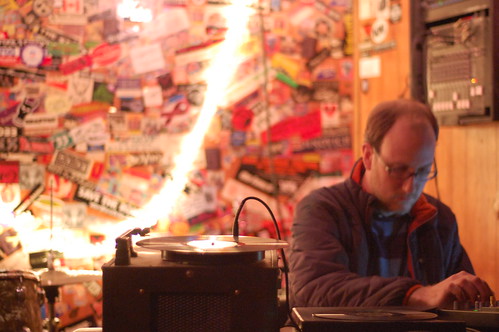
Harnetty rarely plays live, so experiencing his too-short set at the Treehouse felt like a privilege, and the venue’s naturalistic, homey setting was the perfect spot for the intimacy of these songs--except for the frigid temperatures in that back room on one of the coldest nights of the year. Brrr. It wasn’t a scintillating stage show by any means, nor was it intended to be--just the tall, unassuming Harnetty seated below the Treehouse Christmas lights with his gear and occasional sparse accompaniment from others on drums, xylophone, etc. It was a stark contrast of new and old, with a laptop and various knobby devices settled next to an acetate-spinner playing worn, scratchy vinyl, full of authenticating hisses and pops.

Listening to Harnetty’s pastiches feels like eavesdropping on the past. He often includes the moments just before or after an old recording of a tune, capturing revealing comments about songs, or just highlighting the ponderous and sometimes awkward moments when the singer finishes singing--to great effect on “That’s Drunkard’s Dream, Nearly Everybody Knows It.”

Harnetty never overpowers the source material. His subtle accompaniment on the keys and various digital devices lends a sense of deference to the recordings. It’s music to drop your head and close your eyes to. Most of what he played was from the coming Silent City, which will be released on Atavistic this spring. The exciting wrinkle to these new songs is that they sprang from a collaboration with Will Oldham (aka Bonnie “Prince” Billy), who sings over the new arrangements in a way that feels consistent with Harnetty’s previous work. It’s still dreamily Appalachian, and all the lyrics are folk-song fragments combined with phrases from Oldham and Harnetty.

This collaboration with Oldham, whose fans tend to obsess over his prodigious output, could bring Harnetty a new level of exposure, and for good reason. Judging by the tunes he debuted on Friday night, the new stuff is just as strong, if not stronger, than American Winter, retaining that archival quality while inviting a talent like Oldham into his ghostly world.

mp3: Brian Harnetty - That's Drunkard's Dream, Nearly Everybody Knows It

(Also at The Other Paper)

Thursday, January 15, 2009

Ghost Shirt, Couch Forts, Wing & Tusk, Phantods - Skully's

Four local bands played Skully’s on Friday night, and the place was packed. I don’t know if these bands just draw really well, or that was the only thing going on. Or maybe Skully’s always does that well on Friday nights and I just didn’t realize it. Whatever the reason, bully for you, Columbus, for supporting the locals.

For the most part, the bands didn’t disappoint. I was most excited to Ghost Shirt, one of the city’s most promising new bands. Singer/guitarist Branden Barnett led the band through a set of meticulously arranged songs rife with magnetic hooks that felt vaguely familiar but rarely rehashed, taking lessons from the Lemonheads, the Kinks and, like any rock group that embraces its inner pop, the Beatles.

I liked the songs from other vocalist/guitarist Phil Palma, too, but Barnett rightfully took the center stage spot next to Ghost Shirt’s exceptionally smiley violinist. Barnett has an electric presence live, and his strong vocals keep the pretty melodies from ever sounding precious. The slow crooner of the night (“History of the Blue,” I think) was nice, too, though probably a little lengthy for this crowd.

Ghost Shirt apparently has a 10-song demo CD circulating, which I’d like to get my hands on, but I’m hoping I don’t have to wait too long to hear a proper release by this band.

Following up Ghost Shirt was Couch Forts, a three-piece of electric guitar, banjo and violin that drew me in with their extraordinary musicianship. The songs rarely contained chords, instead opting for intricately picked patterns on each instrument that merged to create a surprisingly streamlined melodic base. Somehow this trio made virtuosic complexity sound simple.

Singer/guitarist Owen Kelley sang with unpretentious nerdiness and vigor, sounding like a mash-up of John Darnielle and Colin Meloy. Then, whenever he punctuated the beat with a floor tom, he’d spit lyrics with an edgy impetuosity. I mentioned last week that Couch Forts fit in well with fellow Columbus quirk-folkies Our Cat Philip and Super Desserts, which is true, but this band is still one-of-a-kind stylistically. If three leprechaun musicians woke up one morning and decided to renounce their Irish heritage and supplant it with Appalachia, I think it would sound like the Couch Forts. (The band prefers a shorter description: “yellowgrass.”) The downside is, Kelley’s vocal cadence is so static and the vibe is so consistent that after a few songs it felt like one long song. Some more structural and vocal creativity in the songwriting would be welcome.

Having never seen Wing & Tusk live before, I probably mischaracterized the band a bit in my preview last week by describing its sound as “brittle, Pedro the Lion-esque folk-pop.” There’s definitely some Pedro the Lion in there, and some folk-pop in Wing & Tusk’s recorded material, but live, Wing & Tusk was much more grandiose and sweeping than I had anticipated. (Guess that’s what I get for going solely off a band’s two Myspace songs.) What was brittle, however, was singer Joshua Rea’s voice. I’m OK with brittle voices, but Rea seemed to be going more for reverby, majestic vocals--not unlike a more epic and less pastoral Band Of Horses--and his consistent vocal cracks messed with that feeling some. I don’t know if he was singing out of his range, or if he just a bad night.

That didn’t ruin the songs by any means, though, and the band’s swell-filled rock was a nice contrast to Couch Forts.

The place was still packed when Phantods took the stage to close the night. Gretchen King is Phantods’ main attraction; her soaring vocals are a treat to hear live. I also applaud the band for taking chances and tackling so many genres, often in just one song. But to my ears, the band’s various influences car-crash into each other as often as they complement. The wide swaths of head-banging, metallic guitar don’t always cozy up next to the carousel melodies and waltzy interludes. I’d love to hear more songs where the heavy riffage is toned down, or at least sounds more seamless and less surgically implanted.

(Also at The Other Paper)

Tuesday, December 9, 2008

Moviola, D. Charles Speer & the Helix - Surly Girl Saloon

Friday’s Moviola show was my second Surly Girl concert experience, the first being the Alina Simone/Jerry DeCicca show back in July. Right now Surly Girl is two for two in my book, and I’ll likely head to more in the future if the bar keeps it up.

Only a living room could be more intimate than this space. Pass all the mildly hectic eating and drinking in the front section of the Short North bar/eatery and you’ll eventually hit a curtain that serves as a visual and aural divider. Behind it, there’s the tiniest of stages and some chairs and benches that look more like church pews. Recessed and red-rope lighting cast a warm, subdued glow to the “Parlour.”

Suffice it to say, it was a nice, relaxed setting in which to watch Moviola, a Columbus band that has now been in existence about 14 years, with some silent periods sprinkled throughout. The last proper Moviola full-length came last year in the form of Dead Knowledge, one of 2007’s strongest Columbus releases. This year also saw Spirit of Orr release Broken Horses, a collection of songs from the band’s early period, 1994 to 2001.

Friday night was a pieced-together affair with false starts, flubbed notes and imperfect harmonies, but none of that detracted from my enjoyment too much. Guitarist Jerry Dannemiller opened the night with a nice rendition of “Children, Go Where I Send Thee,” an African-American spiritual/Christmas tune he dedicated to the recently deceased Odetta. I was also glad to hear a fair amount from Dead Knowledge, especially “Rudy,” “Akron to Oakland” and “Spanish Moss.” All five members took turns on vocals, as is Moviola’s custom, including keyboardist Parker Paul, who’s apparently a permanent fixture in the band now; his voice often reminded me of Neutral Milk Hotel’s Jeff Mangum.

I’ve just recently started exploring Moviola’s entire catalog, but I can safely assert today’s Moviola sounds quite different from the ’90s version. There has almost always been a rootsy sound that would make an “Americana” classification tough to dispute, but the band’s fuzzy early days were characterized by a more lo-fi approach, earning them Pavement comparisons that probably weren’t undeserved.

But watching Moviola perform, I couldn’t help but wonder if any slacker-rock tags were, in retrospect, an oversimplification. Maybe the band never was slacker rock, just laid-back and unfussy enough to seem like slackers. Whether in its current, rootsier form or lo-fi campus-kids version, Moviola approaches recording and performing in a relaxed, unstrained way that expresses something honest and true.

Sure, it may seem silly to attempt any deep analysis of five aging musicians on a small stage having some fun on a Friday night for a rare gig. But it made me appreciate Moviola for playing music with such rewarding nonchalance.

The intimate stage wasn’t quite as friendly to New Yorkers D. Charles Speer and the Helix, but only because Speer himself (real name: Dave Shuford) is a tall scarecrow of a man, and Surly Girl’s one little spot lamp was practically butting up against his forehead during the set.

But he was a good sport, and after some adjustments to the mix, Shuford’s baritone carried the songs, especially on some of the more muted country tunes. The band’s skilled lead guitarist needed a lesson or two in knowing when not to play his Nashville riffs, but Shuford’s quirky guitar leads, which were more prone to psychedelic flourishes, were an essential part of each song. That said, I could have used a little more psychedelia in the set. While a couple of these guys also play in uber-experimental troupe No-Neck Blues Band, it was often hard to tell.

mp3s: Download Dead Knowledge for free, courtesy of Catbird Records.
mp3: D. Charles Speer & the Helix - Single Again

Thursday, November 27, 2008

Dean & Britta: 13 Most Beautiful... Songs for Andy Warhol's Screen Tests

There certainly hasn’t been a lack of programming associated with the Wexner Center’s “Andy Warhol: Other Voices, Other Rooms” exhibition, especially of the musical variety. And for good reason, considering Warhol’s inseparability from the Velvet Underground.

There was the Robert Forster event, at which the former Go-Between covered the Velvets; in February, Times New Viking will do the same. And last Thursday, Dean & Britta gave a performance that combined with Andy Warhol visuals to create a captivating hour of mixed media.

“Dean” refers to Dean Wareham, former frontman of genre-shapers Galaxie 500 and its successful follow-up, Luna, of which Britta Phillips eventually became a member. For this show, Dean & Britta performed (mostly) new music to complement 13 of Warhol’s famous “screen tests,” also throwing in a Bob Dylan cover (“I’ll Keep It With Mine”) and a Velvet Underground tune (“Not a Young Man Anymore”).

Warhol made around 500 of these screen tests at his studio, the Factory, each of them being shot with a 16 mm camera on 100-foot rolls of silent, black and white film. The films normally would have lasted 2¾ minutes apiece, but they were projected so that they ended up as 4-minute films, the slight slow-motion effect elongating and exaggerating any movements.

Some of the subjects seen in the featured screen tests were well known. A young Dennis Hopper cycled through several emotions, looking fierce, confused, amused and contemplative. Velvet Underground vocalist Nico, someone who was undoubtedly used to cameras, seemed bored and slightly annoyed. Lou Reed drank a bottle of Coke, making art of a mass-produced item—a concept made famous by Warhol.

Between a few of the songs, Wareham gave a little commentary on the video portraits. Sometimes the background was a nice addition, and other times I wished I had plugged my ears, because the story and emotions I was projecting onto the images were more interesting than the reality.

Take the screen test of Ann Buchanan. While Dean & Britta played a song called “Singer Sing,” the dark-haired, dark-eyed Buchanan gazed unfalteringly at the camera as tears began to well up in her eyes and eventually cascade down her face one at a time. It had me wondering what could be causing so much sadness in her life. Or was it something Warhol was saying in the background of the silent film that we, the viewers, weren’t privy to? And how did she remain so stone-faced with such internal grief?

Perhaps if I’d been more observant, I would have noticed that the tears were merely a result of not blinking for nearly three minutes, as Wareham noted after the song. That explains the stone face and lack of any visible grief other than the tears. Still, I like my version better.

Wareham’s comments about Freddie Herko, on the other hand, were a welcome—if a bit disturbing—confirmation of suspicions I already had. Herko appeared shifty and angry in his screen test, at times looking downright menacing. Something was not right with him, like a man searching for peace but finding the opposite. The band accompanied the portrait with a repetitive instrumental melody that built to an intense climax toward the end of the film.

Turns out Herko, a dancer, committed suicide soon after the screen test. At 29, he leapt out the window of a friend’s apartment. He also was a speed freak, which would account for some of the shiftiness, too.

During the performance, the musicians often faced the video screen, undoubtedly taking cues from the larger-than-life projections. The Velvets cover, appropriately played during Reed’s test, was the only real rocker of the night. Most songs were marked by Dean & Britta’s dream-pop vibe, a nice companion to the portraits.

Wareham’s voice oozed his usual indolent cool, and Phillips’s silky-sweet singing was almost as gorgeous as her runway-model looks. I couldn’t help thinking how well she would have fit in with screen-tested Factory starlets like “Baby Jane” Holzer and Ingrid Superstar.

Adding music to such an iconic project is a daunting and risky proposition, even for someone with as much cred as Wareham. But Dean & Britta’s pop and Andy Warhol’s art melded to make a most beautiful evening, indeed.

Also at The Other Paper

Wednesday, November 12, 2008

Blitzen Trapper, Horse Feathers - Skully's

Blitzen Trapper is on track to become The Next Big Thing. Not a here-today-gone-tomorrow buzz band (remember Black Kids?)--a mainstay.

Here’s proof. First, the Portland band released Wild Mountain Nation last year to moderate acclaim. It’s a good record, if a bit uneven, with a hefty dose of messy slacker rock amid crispy bits of countrified rock. It was Blitzen Trapper’s most widely heard album yet, leading to a deal with Sub Pop and this year’s Furr. Furr is a terrific album of Dylan-inspired tunes that find the band maturing without growing dull--a tough feat. Expect to hear more about this record as the audience grows.

And so all that’s left to solidify Blitzen Trapper as a force to be reckoned with is its live show, and the six-piece proved Tuesday night at Skully’s that it’s more than capable of winning hearts and minds from the stage.

In the big scheme of things, bandleader Eric Earley’s chiseled good looks probably won’t hurt Blitzen Trapper’s coming ascension, either. Earley is the band’s songwriter, usually writing songs on his own and recording/producing lots of them himself in the studio. But Blitzen Trapper doesn’t feel the least bit like a solo project. On stage the band is a tight, finely tuned machine, and each part is integral in making the gears turn.

There were only a few Pavement moments Tuesday night, “Love U” being one of them. Most other songs mixed the band’s fuzzy past with its furry present. “Gold for Bread” was one of the best examples of how well Blitzen Trapper mixes the old with the new, taking an energetic rocker and giving it an unmistakable Western vibe.

The full room responded most to “Furr,” the superbly written centerpiece of the band’s new album. The acoustic-based tune is a songwriting exemplar that uses Dylan as inspiration, yet still manages to feel original. The creative, more electric live arrangement brought spontaneous, simultaneous cheers from the crowd at certain points. (See? A finely crafted song can even get hipsters all worked up.)

There’s no reason for the band to ditch older songs like “Country Caravan” or “Wild Mountain Nation,” either. It allows the Oregonians to unleash a more playful side. That side came out during the encore, especially on “Miss Spiritual Tramp” (“It was a drive-by/ Columbian necktie”) and a cover of Dolly Parton’s “The Last Thing on My Mind.”

Tour mate and fellow Portlander Horse Feathers, on the other hand, wasn’t playful in the least. The guitar-violin-cello trio played quiet, folky songs you’d expect to hear coming from inside the snowy, wintry barn on the cover of the band’s most recent record, House with No Home.

It was a strange juxtaposition to have a such a hushed, lulling band bathed in Skully’s pink lighting underneath a disco ball, but eventually everyone caught on to the vibe and quieted down, allowing singer Justin Ringle’s tenor to carry. Ringle’s voice is soothing, and he has a calm presence to match it. He also happens to look a lot like Ron Howard--the bearded, director version of Ron Howard, not Opie or Richie Cunningham.

The live performance offered more dynamic range than House with No Home, which suffers from a bit of sameness. But the strings provided plenty of interest Tuesday night, even when Ringle’s singing began to sound a bit repetitive.

“Working Poor” featured a violin riff that hung in the air long after it was gone. The violinist also played the saw for a tune called “Heathen’s Kiss.” Maybe it’s a gimmick, but I give extra points to any band that successfully employs a cutting tool in its songs.

mp3: Blitzen Trapper - Furr
mp3: Horse Feathers - Curs in the Weeds

Wednesday, November 5, 2008

Chairlift w/ Moon High - Wexner Center, 11-3

You gotta hand it to the folks at Apple. They’re pretty good at finding just the right songs to soundtrack all those boldly colored iPod TV ads. The most recent commercial for the Nano is no exception. While watching those new gadgets bleed their vivacious colors, you’ll hear Caroline Polachek of the band Chairlift singing about handstand attempts over the bounciest bass line allowed by law. The song is called “Bruises,“ and it’s playful, catchy, hummable, vaguely familiar--all the things Apple is going for in hopes that those Nanos will fly off the shelves, economic crisis be damned.

But Feist has no need to worry. She won’t be relinquishing the iPod-commercial crown to Chairlift anytime soon. For many, “1234” served as a jumping-off point for discovering other gems in the Feist catalog, but judging from Chairlift’s sparsely attended show at the Wexner Center’s Black Box on the Mershon stage, an exploration instigated by “Bruises” turns up a lot of filler from a band still searching for an identity.

That’s not to say that this Brooklyn three-piece doesn’t have some stuff worth hearing, namely the songs where Polachek showcases her tremendous pipes. “Make Your Mind Up” was the most impressive of Monday night’s very brief set, as Polachek’s soulfulness spilled over the levee, revealing a beautiful vocal tone and an uncommonly high range. The song made her slightly bothersome theatrical gestures (draping herself over the keyboard, etc.) seem more justified.

“Bruises” came off just as it should have, and the short-and-sweet “Evident Utensil” was nice and danceable, despite some rhymes that felt a little forced. But the rest of the set was spotty as Chairlift attempted U2 (“Deer Hunt”), French pop and some industrial-inspired stuff.

“Planet Health,” the closer, mentioned something about a food pyramid, puberty and saying no to drugs, with a chorus of, “I’m feeling great tonight.” It’s a snoozer till the the song’s resilient outro (“Stop, drop and roll”), but by that time it was a little late, and I was still befuddled about this planet Polachek was attempting to describe.

Until Chairlift learns to consistently harness Polachek’s voice, sharpen its focus stylistically and mature a bit lyrically, it’s probably not worth filling up that Nano with more than a couple Chairlift tracks.

Moon High, on the other hand, has created and fully embraced a unique identity. The local band’s ultra-mellow, organic folk--an odd contrast with Chairlift’s synth-heavy sounds--is unlike any other band in Columbus, and you’d have trouble finding an equivalent outside of Ohio, too. People like to lump Moon High in with freak-folk bands, and David Fowler and Ryan Wells may take some inspiration from that scene, but reducing the band to that label does it a disservice.

Fowler and Wells shared lead vocal duties and switched between various acoustic guitars, banjo and cello throughout the set, accompanied by flute and violin at times from the two female background singers. Moon High completes its aesthetic visually with a couple of large, foot-switchable, white globe lights that I find more warm and peaceful than gimmicky.

Just about all of the band’s songs have a mournful vibe, and that consistency does come with a small price. If you head to a Moon High show with some sleep debt, the tranquility of “Lying Here, Dying Here,” “Where You Go” and other songs can become a bit drowsy. But these guys aren’t trying to shake the rafters, so I have a feeling that if you kicked back and closed your eyes at a show, they might take it more as a compliment than an insult.

Thursday, October 30, 2008

This week's Other Paper

I'm getting lazy, so I'll just refer you to TOP's site for stories with my byline this week:

Concerts
Live review of Magnetic Fields (above) at the Southern Theatre last Friday

Locals
Review of Times New Viking's just-released Stay Awake 7"

Review of Ugly Stick's Still Glistening, the band's first release in 14 years

Review of Team Smile and Nod's Look Both Ways Before You Die